Getting the right information about the NSFAS Eligibility Requirements for Funding can be the difference between starting your tertiary education or being left behind. The National Student Financial Aid Scheme (NSFAS) is a government bursary designed to remove financial barriers for students from poor and working-class families in South Africa. This comprehensive 2026 guide will walk you through every single requirement, rule, and document you need to know to determine your eligibility and apply successfully. Understanding these criteria matters because applying without meeting them is the most common reason for rejection. Let’s make sure you get it right the first time.
What Are the NSFAS Eligibility Requirements for Funding and Why They Matter
The NSFAS Eligibility Requirements for Funding are the non-negotiable criteria set by the government to determine which students qualify for financial aid. They are designed to ensure that limited bursary funds are allocated to those with the greatest financial need and academic potential.
This isn’t just a box-ticking exercise. Understanding these requirements matters profoundly to you as a student. It allows you to:
- Assess your chances before investing time in the application.
- Gather the correct documents proactively, avoiding last-minute panic.
- Submit a compliant application that progresses smoothly through the system.
- Secure funding that covers your tuition, accommodation, food, and books.
Who the NSFAS Eligibility Requirements for Funding Are For
These requirements are designed for South African citizens whose family’s combined income falls below a specific threshold. They are for students who have been accepted or are seeking to study at a public university or Technical and Vocational Education and Training (TVET) college.
What Meeting the NSFAS Eligibility Requirements Covers Financially
If you meet all the NSFAS eligibility requirements for funding and are approved, you receive a comprehensive bursary that covers:
- Full Tuition Fees: Paid directly to your institution.
- Accommodation: Covered as per your university/TVET college’s accredited residence costs or an approved private accommodation allowance.
- Learning Materials Allowance: For books, stationery, and other course necessities.
- Personal Care/Living Allowance: A monthly stipend for food and essentials.
- Transport Allowance: For students who don’t qualify for accommodation funding.
Who This Topic Applies To
First-Time Applicants (Matriculants & New Students)
If you are in Grade 12 or have just matriculated and are applying to a university or TVET college for the first time, these NSFAS eligibility requirements for funding are your primary guide. Your application will be assessed on your household income and your admission status.
Returning NSFAS Students
If you are already receiving NSFAS funding, you must continue to meet the academic progression rules (like the N+2 rule) to remain eligible each year. Your funding is not automatic and is re-evaluated annually.
Returning Students Seeking New Funding
If you are a university or TVET college student who was previously self-funded or funded by other means, and your financial situation has changed, you can apply. You must also meet the academic progression criteria.
TVET College vs. University Students
The core NSFAS eligibility requirements for funding are the same for both pathways. The key difference lies in the approved qualifications and the application process through your chosen institution. TVET students must be enrolled in specific programmes.
SASSA Grant Beneficiaries
If you or your parent/guardian is a recipient of a South African Social Security Agency (SASSA) grant, you automatically meet the financial eligibility criteria. However, you must still submit an application and meet all other citizenship and academic requirements.
The Complete List of NSFAS Eligibility Requirements for 2026
To qualify for NSFAS funding, you must satisfy ALL of the following mandatory criteria. Missing even one will result in your application being declined.
1. Citizenship Requirement
- You must be a South African citizen.
- You must possess a valid South African ID (a green barcoded ID book, a smart ID card, or a valid temporary ID certificate).
- Asylum seekers, permanent residents, and refugees are not eligible for NSFAS funding.
2. Financial Need: Household Income Thresholds
This is the most critical filter. The combined gross annual household income must not exceed:
- R350,000 per year for all applicants.
- R600,000 per year for applicants living with a disability.
How is “household income” calculated?
It is the total income of everyone who financially supports you or lives with you. This typically includes:
- Your biological or adoptive parents (whether married, separated, or single).
- Your legal guardian(s).
- Your spouse, if you are married.
3. Academic Eligibility Requirements
- For First-Time University Students: You must have passed Grade 12 (Matric) and have a provisional or final acceptance letter to study at a public university for an approved undergraduate qualification.
- For First-Time TVET College Students: You must have passed at least Grade 9 and have a provisional or final acceptance letter to study at a public TVET college for an approved NC(V) or Report 191 programme.
- For Returning Students (Academic Progress): You must meet your institution’s policy for academic progression. Crucially, you must comply with the NSFAS N+ Rule.
- Understanding the N+2 Rule: ‘N’ is the minimum number of years allocated to complete your qualification. NSFAS will fund you for N years plus 2 additional years (N+2). If you take longer, you lose your funding eligibility.
4. Institution and Qualification Requirements
- You must be registered or intending to register at a public university or public TVET college in South Africa.
- NSFAS does not fund studies at private colleges or universities.
- Your chosen qualification must be accredited and supported by NSFAS.
Special Cases and Supporting Documentation
Students in these categories meet the financial means test automatically but must provide specific proof:
- Students Living with Disabilities: Must submit a completed and signed Disability Annexure A Form (available on the NSFAS website).
- Orphans: Must provide a death certificate(s) for parent(s).
- Vulnerable Children (as defined by the Child Care Act): Must provide a Vulnerable Child Declaration Form from a social worker.
- SASSA Grant Recipients: Must provide proof of the SASSA grant.
Checking NSFAS Eligibility Criteria for Application: Step-by-Step Process
Follow this clear path to navigate your NSFAS application based on the eligibility requirements.
Step 1: The Pre-Check (Before Applications Open)
Gather your and your parents’/guardians’ ID documents. Have an honest discussion about total household income from all sources. Check the minimum admission requirements for your desired course.
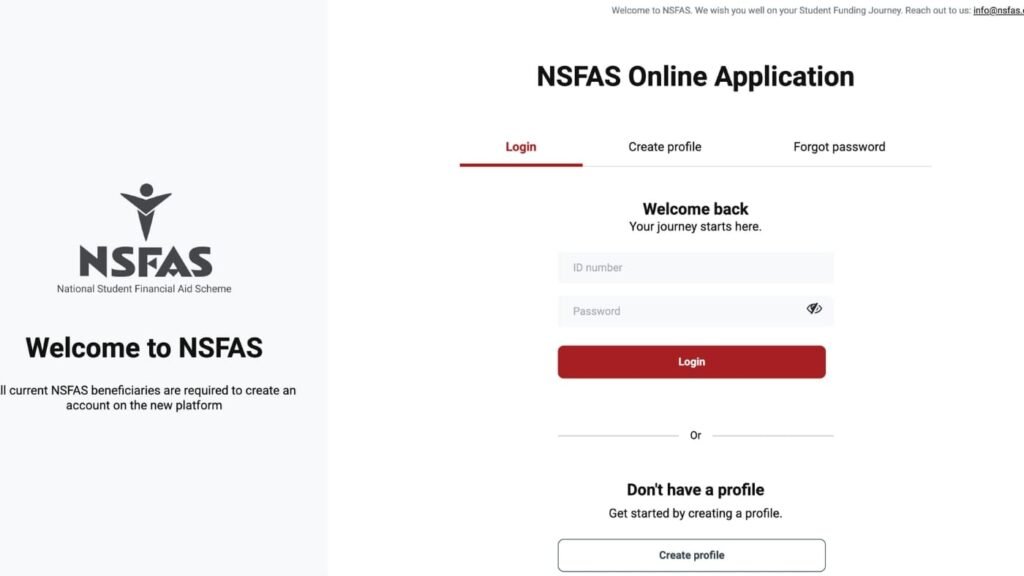
Step 2: Create Your Permanent myNSFAS Account
- Go to the official website: www.nsfas.org.za.
- Click on ‘myNSFAS’ and register.
- You will need your ID number, a personal email address (not a school email), and a cellphone number.
- This account is for life—use it for all future applications and NSFAS status checks.
Step 3: Complete the Online Application Form
- Log in during the open application period.
- Fill in every field with extreme care. Ensure all names and ID numbers match official documents exactly.
- Accurately declare all sources of household income.
- Consent to NSFAS verifying your information with SARS, SASSA, and the Department of Home Affairs.
Step 4: Upload Certified Supporting Documents
- Upload clear, certified copies of every required document (see list below).
- Ensure files are the correct format and size.
Step 5: Submit and Record Your Details
- Submit the application. You will receive a reference number.
- Save this number and take a screenshot of the confirmation for your records.
Step 6: Monitor Your Application Status
- Regularly log into your myNSFAS account to track your application.
- Look out for statuses like “Submitted,” “Filtering,” “Evaluation,” “Funding Eligibility,” and finally “Approved.”
Documents Needed to Prove Your NSFAS Eligibility
You must submit certified copies. An uncertified document will cause your application to be stalled or rejected.
Mandatory Documents for ALL Applicants:
- Certified copy of your South African ID.
- Certified copy of the ID of your parent(s), guardian(s), or spouse.
- Proof of income (if applicable): Latest payslips (not older than 3 months), employment letter, or pension advices.
- If parents/guardians are unemployed: A sworn affidavit or proof of SASSA grant.
- NSFAS Consent Form: Downloaded from the website, completed, and signed by all parties whose income is declared.
Additional Documents (If Applicable):
- Death certificate(s) (for orphans).
- Vulnerable Child Declaration Form.
- Disability Annexure A Form.
- Academic transcript/record (for returning students).
Certification Rules
- Documents must be certified by a Commissioner of Oaths (Police Station, Post Office, Lawyer).
- The certifier must write “Certified true copy of original,” sign, date, stamp, and provide their full name and contact details.
- Certifications should not be older than 3 months at the time of application.
File Format and Upload Tips
- Use a scanner or a clear smartphone camera scanner app.
- Save files as PDF, JPEG, or PNG.
- Keep file sizes small (under 2MB) but ensure text is readable.
- Name files clearly (e.g., YourName_ID_Document.pdf).
Common NSFAS Eligibility Problems and Solutions
Problem 1: Application Rejected Due to “Household Income Exceeds Threshold”
- Solution: Double-check the figures you submitted. If you believe it’s an error (e.g., a parent lost a job), you can appeal during the official appeal window with new, verifiable proof of income.
Problem 2: “Invalid ID Number” or “ID Already Exists” Error
- Solution: This often means you have an existing myNSFAS account (perhaps from a previous application). Use the ‘Forgot Password’ feature. If stuck, contact the NSFAS call centre with your ID ready.
Problem 3: Missing Documents or Application Stuck on “Filtering”
- Solution: Log into your myNSFAS account and check the ‘Track Application’ section for messages. You likely have a notification to upload a missing document. Address this immediately.
Problem 4: Academic Eligibility Failure (N+ Rule)
- Solution: If you have exceeded the N+2 years for your qualification, you are no longer eligible for NSFAS funding. You must seek alternative funding or make a payment arrangement with your institution.
Problem 5: Approved for Funding but Not Registered
- Solution: Your status will say “Awaiting Registration.” NSFAS cannot pay until your university or TVET college confirms your registration details. Ensure you have formally accepted your academic offer and completed registration.
Important Tips and Warnings
Avoiding NSFAS Scams
- NSFAS will NEVER ask you for your myNSFAS password, PIN, or OTP.
- No one can “fast-track” your application for a fee. The application is FREE.
- Only use the official www.nsfas.org.za website and their verified social media pages (with the blue tick).
- Beware of fake WhatsApp numbers and Facebook pages pretending to be NSFAS agents.
Deadlines to Watch
- The application period for 2026 will likely open in September 2025 and close in January 2026. DO NOT wait for your Matric results. Apply as soon as it opens.
- Appeal windows are short and strictly enforced. If rejected, act immediately when appeals open.
Top Mistakes That Lead to Rejection
- Incorrect Personal Details: A typo in your ID number or a name that doesn’t match your birth certificate.
- Incomplete Forms: Leaving required fields blank.
- Uncertified or Poor-Quality Documents: Blurry photos or copies without a stamp/signature.
- Missing the Application Deadline: Late applications are almost never considered.
Frequently Asked Questions (FAQ)
What are the basic NSFAS eligibility requirements for funding?
You must be a South African citizen, have a household income under R350,000 per year (or under R600,000 if you have a disability), and be accepted to study at a public university or TVET college.
Can I apply for NSFAS if my parents are unemployed?
Yes. You must provide a sworn affidavit stating they are unemployed and have no income, or provide their SASSA grant confirmation documents if they receive one.
How do I check if I am eligible for NSFAS before applying?
Use the official NSFAS eligibility criteria in this guide as a checklist. The only official confirmation, however, comes from submitting a complete application and receiving a “Funding Eligible” status on your myNSFAS account.
What does the N+2 rule mean?
It means NSFAS will fund you for the minimum number of years (N) your qualification requires, plus two additional years. If your degree is 3 years (N=3), you get funded for up to 5 years (N+2).
Do I qualify for NSFAS if I have a disability?
Yes, and your household income threshold is higher (R600,000). You must submit the Disability Annexure A Form as part of your application.
What if my NSFAS application is rejected?
You will be given a reason. If you believe it’s incorrect (e.g., wrong income assessment), you can submit an appeal with supporting documents during the official appeal period announced by NSFAS.
Conclusion:
Understanding the NSFAS Eligibility Requirements for Funding is the most powerful first step you can take towards securing your future. This guide has provided you with the definitive checklist for 2026. The process demands attention to detail, honesty, and prompt action, but the reward—a fully funded education—is life-changing.
Start preparing your documents today. Engage your family in the financial discussion. When applications open, apply early and accurately. Use your myNSFAS account as your source of truth. You have the potential and the right to pursue your studies. Let meeting these requirements be the key that unlocks the door.
1. NSFAS South Africa Student Funding Eligibility
2. How to Check NSFAS Status Online
3. How to Login MyNSFAS Account
4. How to Apply for NSFAS Online
5. How to Create myNSFAS Account Online
1 comment
I am 36 and trying to study further can you contact me on this email.